

Alex Rutherford, Policy and Learning Officer, Tropical Health and Education Trust (THET)
Jessica Fraser, Programmes Coordinator, THET
Kit Chalmers, Head of Policy and Learning, THET
Katthyana Aparicio, Programme Officer, Quality of Care Unit, WHO
Bangladesh, Ghana, Lesotho, Myanmar, Uganda, United Kingdom of Great Britain and Northern Ireland
• Institutional health partnerships built on established relationships helped provide mutual support during the COVID-19 pandemic.
• Rapid adaptations were necessary and were facilitated by the flexibility of the health partnership approach.
• Many adaptations made by the THET Health Partnerships map to the steps within WHO’s Twinning Partnerships for Improvement model, highlighting its utility in guiding partnership development and implementation, in a variety of circumstances and domains, including emergencies.
• Adopting new ways of working often brought unexpected benefits, including a rebalancing of power within partnerships, the development of new leaders, and the creation of virtual solutions which will be beneficial in the future, particularly in terms of communication and reach.
• Learning from adaptations made in response to the COVID-19 pandemic will help to guide future developments, improving the ability of health partnerships to strengthen health systems globally, whether or not during a time of crisis.
Health partnerships, as described here, are long-term relationships between health institutions in the United Kingdom and their counterparts in low- and middle-income countries (LMICs). They aim to deliver sustainable improvements in health services and systems through the reciprocal exchange of skills, knowledge and experience. They may or may not use the WHO Twinning Partnerships for Improvement (TPI) model, but they are based on the same core principles of collaboration, co-development and sharing of knowledge.
Despite domestic pressures on their health services, many health partnerships developed activities to provide mutual support in the face of the COVID-19 pandemic. Practicalities and needs changed; for example, the travel which many projects depend on was no longer possible, and the demands on services created new priorities for urgent action to maintain quality essential health services.
This learning brief brings together tangible examples of the adaptations made by health partnerships supported by THET during the COVID-19 pandemic. Most of these partnerships are based on a long history of collaborative work and well-established relationships, which facilitated flexibility. We map their adaptations to the six steps of the TPI model, showing its strengths and providing useful examples for partnerships, whether or not they are facing a crisis.
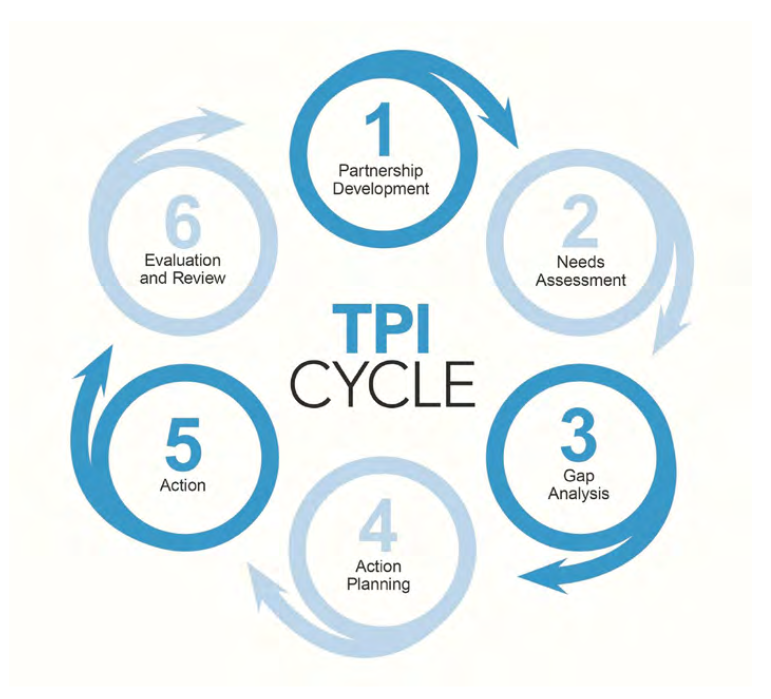
Step 1: Partnership development
Even well-established partnerships continued to develop during the COVID-19 pandemic, particularly in terms of communication and leadership. Many began communicating more regularly, supported by the rapid growth in virtual connections driven by the pandemic, and secured senior agreement on both sides to take joint action.
A Bangladesh-UK partnership found that remote working, or working from home, actually increased leadership within Bangladesh. For instance, midwives took on the responsibilities previously held by UK partners, who would otherwise have travelled to co-deliver activities. More frequent, informal communications facilitated rapid troubleshooting, and activities progressed faster and more flexibly than prior to the pandemic. Remote working widened participation in both countries: in Bangladesh, virtual activities were delivered in difficult-to-reach areas, while in the UK, more participants were involved since no travel was needed.
In this case, adaptations led to a deepening of the partnership in terms of relationships, reach and participation, all of which will help to strengthen future activities.
Health partnerships often undertake needs assessments together, with UK partners travelling to take part. This model had to change due to travel restrictions.
A Uganda-UK partnership decided to use experienced Ugandan staff to lead this process. The hospital director and hospital pharmacist developed a standardized assessment tool, in collaboration with wider local teams and involving the UK team virtually. Final changes were then made following consultation with each department of the hospital and other relevant staff.
To improve inclusivity, a Ghana-UK partnership held focus group discussions with women and girls, to explore how COVID-19 was impacting their access to facilities. UK partners provided input virtually, and all views were included in the determination
of needs, resulting in a baseline assessment inclusive of diverse perspectives and expertise.
Most health partnerships identified specific needs related to COVID-19, and active projects were adapted to address these. Gaps in training and a need for practical and psychosocial support were widespread. Modifications in national and regional priorities sometimes offered an opportunity to influence at high level, or on a wider scale, based on the partnerships’ recognized knowledge of context and potential gaps.
One health partnership involved in the Commonwealth Partnerships for Antimicrobial Stewardship programme (CwPAMS) was asked to inform the development of the regional COVID-19 response, due to existing connections with key stakeholders built through their partnership activity.
Another partnership found that COVID-19 led to a recognition at senior level of infection prevention and control (IPC) measures developed during a previous project. Seeing gaps in this elsewhere, the measures were adopted more widely, leading to improvements in hand hygiene across the hospital.
Having identified the need, early prioritization of IPC training by a UK-Ghana partnership improved practices before COVID-19 became a severe threat, thereby achieving greater impact by cascading the training to greater numbers of staff.
In response to changing short- and long-term plans, several health partnerships held virtual meetings to assess capacity, and to make contingency plans to meet project objectives virtually. This was supported by regular communication via online meetings and conference calls.
Contingency planning included adequately equipping the LMIC partner institutions to facilitate virtual workshops, for instance by supporting internet access and hardware.
The training of participants was supported with better internet access, and sometimes orientation on the use of online platforms.
One health partnership has found that the experience built at the height of the pandemic has established new practices and confidence in virtual programme delivery, which will support future projects.
Step 5: Action
Most health partnerships switched from in-person to online delivery of training, with other adaptations tailored to individual contexts. For example, in Uganda, some in-person training continued, but with more frequent, smaller sessions to comply with COVID-19 measures. This placed greater demand on trainers, but benefitted participants by increasing individual interaction with the trainers.
Activities were based on needs assessments and gap analyses, and were aligned with national plans to deliver quality essential health services during the pandemic. This often involved greater community engagement, particularly where health partnership activities were focused on IPC. This increased understanding of community needs and allowed the development of context- specific resources, such as songs and guidance in local languages.
In Myanmar, adaptations were shaped both by the challenges of COVID-19 and the 2021 military coup. For example, a project supporting medical student training by general practitioners (GPs) pivoted to strengthening the overall capacity of GPs, in response to safety concerns. This included the development of treatment guidelines for the management of patients with severe COVID-19.
Step 6: Evaluation and review
Most health partnerships undertook careful review of their new activities, adapting over time and learning for the future.
For example, a UK-Lesotho partnership evaluated their first virtual training in nursing, confirming that key indicators for effectiveness had been met and participants felt ready to implement their learning. They then undertook longer- term evaluation, finding improved health outcomes within the local population, and better engagement and motivation among the health workers involved. Nurse managers in Lesotho felt more confident in their ability to develop teaching and nursing care plans, supporting long-term effectiveness of the activities and the health partnership.
Health partnerships made certain adaptations at various stages in the steps of the TPI model in response to the challenges of the COVID-19 pandemic. Many adaptations brought positive developments for the future, for example in partnership communication, power balance and community involvement. These examples show the strength, both of the TPI model, and the Health Partnership approach, which is flexible and able to deliver locally-appropriate solutions. We, therefore highly recommend that partnerships review the TPI steps whenever there are changes in context.
These HLH action briefs and learning briefs are presented for learning purposes only. Their content has been developed by the organization and author(s) named and as such does not necessarily represent the policies or approaches of WHO.
.tmb-1920v.png?Culture=en&sfvrsn=54737d84_1)