

Dr Feliciano da C.A. Pinto, Director General, Cabinet of Quality Assurance in Health (CQAH), Timor-Leste
Dr Helder M de Carvalho, Head of Accreditation and Standardization Service (ASS), Timor-Leste
Sara Maria Filomena Xavier, Head of Cabinet of Quality Control, National Hospital
Guido Valadares, Timor-Leste
From WHO Country Office:
Melissa Kleine-Bingham, WHO Timor-Leste Consultant
Dr Rajesh Pandav, WHO former WR, Timor-Leste
Dr Vinay Bothra, WHO Health Policy Adviser
Jayendra Sharma, WHO Timor-Leste Consultant
Basilio Martins Pinto, WHO Programme Associate for Health Systems
Timor-Leste
• Twinning partnerships for improvement (TPIs) are designed to enhance quality of care through fostering a two-way relationship that has an impact at both a systems and an institutional level.
• The approach can work to support the efforts of both partners
to respond to emergent public health threats and emergencies – as demonstrated by the response of the Macao SAR/Timor-Leste TPI during the COVID-19 pandemic.
• Implementation of the TPI approach in Macao SAR/Timor-Leste facilitated critical IPC improvements
in essential health services at a time when these improvements were urgent. Although COVID-19 required a tilt in planned activities, a robust quality improvement plan supported innovation, flexibility and commitment.
• TPIs are constructed to be flexible
in nature, allowing them to respond to the evolving needs of partners – an approach which amplifies the benefits associated with TPIs for countries involved.
• The relationships forged between health services through TPIs, can provide the foundation upon
which international collaborative efforts can respond to future global health crises.
Twinning partnerships for improvement (TPIs) constitute an innovative collaborative approach to enhancing the quality of healthcare services throughout the world. Partnerships facilitate two-way learning by creating opportunities for partners to learn
from each other in ways which support long-term, sustainable efforts on quality of care. During 2018–2020 a TPI between Macao Special Administrative Region, China (Macao SAR) and Timor-Leste undertook a programme of activities in order to improve
the quality of health care in Timor- Leste, primarily focused on infection prevention and control (IPC). The partnership was based on the World Health Organization (WHO) model for twinning partnerships which follows a 6-step partnership improvement
cycle of: (1) partnership development; (2) needs assessment; (3) gap analysis; (4) action planning; (5) action and (6) evaluation & review.
Foundational discussions for the Macao SAR/Timor-Leste TPI started in 2017, with the bulk of TPI activities
conducted in 2020. Due to the COVID-19 pandemic, many planned TPI activities had to be substantially adjusted to tilt towards the evolving needs of the health service in Timor-Leste. Despite the challenges posed by the pandemic, improvements were made
in all of the four agreed TPI quality improvement (QI) areas of activities of: training; infrastructure; hand hygiene; and building the IPC programme. In fact, given the urgent needs of the pandemic, the TPI contributed to strengthening IPC both within
and beyond the three participating health facilities in Timor-Leste.
The overall aim of the TPI was to improve the quality of service-delivery in Timor-
Leste through support to the Cabinet of Quality Assurance in Health (CQAH).
Due to the COVID-19 pandemic (declared by WHO in March 2020), many planned
TPI activities had to be refined based on the immediate context and the work of
the TPI shifted focus towards IPC to support Timor-Leste’s efforts in pandemic
preparedness, as directed by its MOH. Please see Figure 1. below:
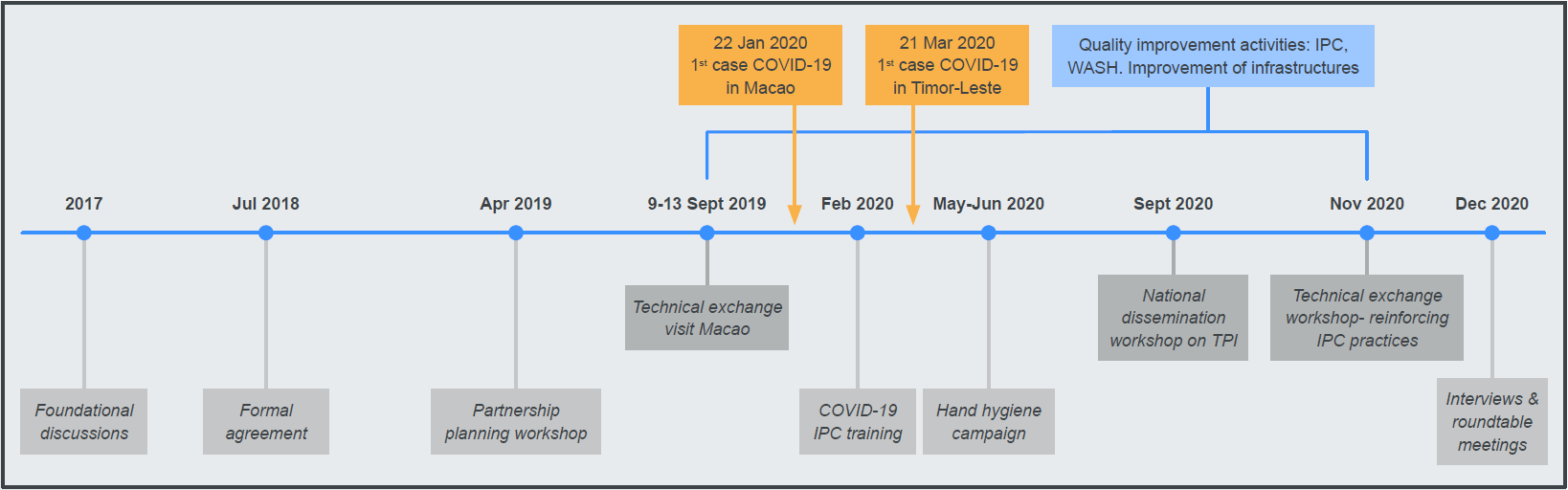
Figure 1. Timeline of TPI events - the trajectory of the impact of the COVID-19 pandemic
The COVID-19 pandemic had a major impact on the implementation of TPI activities and the partnership rapidly adapted accordingly. The first case of COVID-19 in Timor-Leste was declared on 21 March 2020 and even prior to this the partnership swiftly recognized the critical importance of IPC practices in combating COVID-19. The direction of TPI activities thus tilted towards strengthening Timor-Leste’s pandemic preparedness response (while also sharpening Macao’s preparedness activities). Various TPI activities in the health services (such as the provision of IPC training for health professionals focused on cleaning, hand hygiene, doffing and donning of PPE and waste management) as well as workshops held at border isolation and quarantine facilities for non-health workers (security, police, administrative staff, hotel cleaners etc.) contributed to this preparedness.
Under the original TPI plans, the objectives included: building IPC teams, IPC training, improving WASH infrastructure and efforts to enhance hand hygiene – all of which also helped to prepare for and later respond to the COVID-19 pandemic. With Macao SAR supporting these four TPI objectives in Timor-Leste, and the Timor-Leste CQAH leadership driving the improvements, the three participating health facilities in Timor-Leste were able to better prepare and scale-up IPC capacity in their respective facilities and communities.
Despite delays in training and in construction of health facility infrastructure, once Timor-Leste’s pandemic response plan was announced, pre-existing TPI resources and infrastructure were utilized to support hand hygiene efforts, IPC training and urgent construction of WASH infrastructure improvements in the context of the COVID-19 response. This direct support allowed clean water to be consistently available at the three facilities; and also facilitated capacity building with respect to delivery of best practice training to staff regarding standard precautions, transmission-based precautions and PPE.
During the initial phase of the COVID-19 pandemic, the TPI enabled and empowered Timor-Leste to provide health workers with essential, up to date knowledge and training in the area of IPC, and thus respond in a timely manner to the immediate need. Two particular activities allowed cascading of expertise. First, a National Dissemination Workshop in September 2020 to disseminate the learning from the TPI with a specific focus on IPC in the context of COVID-19.
Second, a dissemination workshop in November 2020 which supported the strengthening of health facility level leadership in improving IPC.
The unexpected events experienced worldwide during the COVID-19 pandemic perfectly illustrate why a twinning partnership should be inherently flexible and adaptable to evolving needs, thus enabling the ultimate benefits of the TPI to be far greater than those initially envisaged at the outset of the partnership.
Multiple lessons were learned through the Macao SAR/Timor-Leste TPI journey with respect to the maintenance of essential health services. Some of these, focused on applying quality improvement approaches to IPC during the COVID-19 pandemic are detailed below.
Adaptation of meeting modalities
Early efforts are required to switch to virtual meetings to facilitate social
distancing and implementation of IPC best practices during the COVID-19
pandemic. Make use of teleconferencing, videoconferencing/virtual meetings
and other technological tools where possible as an alternative to face-to-face
meetings. Ensure all team members have access to these modalities and are
familiar with their use.
Unexpected events – challenge or opportunity
It is easy to lose momentum and enthusiasm if planned processes and timelines
are derailed by unexpected events. Review plans and see what can be adjusted
in new and evolving circumstances. Remember that unexpected events such as
COVID-19 can provide new opportunities for both partners to swiftly meet urgent
needs and demonstrate the value of the partnership.
Lack of QI team &/or IPC team
Facilities with an established QI team &/or IPC team can move more rapidly to upscale
urgent input to maintaining health services. If such a team is not in place, it
should be established as a priority when tilting towards the COVID-19 context.
Unsuitable training materials
The context requires rapid adaptation and iteration of training materials. It is
important to contextualize training materials and simplify or change interventions
as needed.
Lack of confidence and clarity amongst staff
Healthcare staff involved in IPC efforts need to develop confidence in their
abilities and be clear about their respective roles. Peer-to-peer learning can help
build confidence amongst healthcare workers, particularly in more unsupported
parts of the health service during emergencies such as COVID-19. Worker-to worker
interactions provide entry points for technical and emotional support.
Deciding on actions to undertake
This can be difficult to prioritize, requiring the choice of simple starting points and
tools. It may be prudent to begin with discrete actions that have the potential to
generate early wins. Alternatively, a multi-stage/phased implementation of
improvements helps, especially in cases of infrastructure improvements. The first
stage should cover essential tasks with high likelihood of attaining successful
outcomes.
Planning for spread activities
Consider “horizontal” (facility-to-facility at the same level),
“vertical” (between national, district and community-level facilities) and
“spontaneous” spread possibilities at every stage of the partnership.
This is particularly important in cascading crucial knowledge and skills to
the maximum number to ensure greatest benefit.
.tmb-1920v.png?Culture=en&sfvrsn=54737d84_1)